Showing posts with label Rhineland Palatinate. Show all posts

Sunday, 5 February 2017

Walking the Weinsteig Rheinland Pfalz, Germany Stage 4: Deidesheim to Neustadt an der Weinstraße

Walking the Weinsteig: Deidesheim to Neustadt an der Weinstraße Stage 4: 15.5 km; 5 hours; 650 m climb 
February 28, 2016 Weather, dry, cool (9°C), overcast
This stage is fairly strenuous with plenty of scenic variety, including good views over the vineyards south of Deidesheim. The little town has attracted artists and as we walked towards the old Town Hall with its tremendous steps we noticed amusing and atractive sculptures adorning several buildings. Of course if you are with a group or children the figures around the fountain near the station require a stop. We dragged ourselves away from the beguiling menu boards and angled left then into the narrow streets lined with stone cottages. Soon the houses petered out, the road climbed gently between high stone walls on the edge of vineyards and became a rough track. Shortly we left the shelter of the vines, climbing into meadows, and up a wide grassy slope. A glance back revealed that we were already high above Deidesheim and approaching the Pfalzblick restaurant 200m ahead. a popular lunch stop, especially at weekends. Soon we are back in the familiar mix of pines and chestnuts climbing easily, then back down to a small white chapel, the Klausenkapelle, where there are occasionally services. Up again above the village of Königsbach, with its notable church tower. Maddeningly there is a steep descent down steps, with fragile wooden handrails right into the churchyard. We contoured along a series of alleys to an open view of vines, with Gimmeldingen village ahead below. This is a pleasant snack stop with a few picnic bench, especially if the magnificent rose bushes are in flower to attract bees (to fertilise the vines). Though a cold Spring this year, almond trees were flowering around Gimmeldingen. The festival in celebration, with stalls, vino tasting and local foods was postponed until later in March (still very chilly). Our trail headed steeply uphill partly up irregular stone steps. We were feeling quite perky until we reached the steps and climbed to Meerspinnblick, where there is a wooden shelter. Hunger suddenly struck both of us so we perched on a convenient bench where various walkers wished us "Guten Appetit" as we ate our lunch.
We had forgotten the rather demoralising drop into and along the valley deeply into the woods. From  Forsthaus Benejental the real work of the day began, up, along, up into the Scots pine and heather clad hills towards Weinbiethaus. Fortunately we were encouraged by various signposts and indeed  distances and the additional climbing needed did get smaller. En route great blocks of stone and weathered outcrops, clumps of heather and chestnut trees gave way to eerie looking Scots pines and even traces of snow. Eventually the low welcoming restaurant building of Weinbiethaus appeared with the stone tower behind.
Maybe it was the anticyclonic gloominess of the day but both of us were glad to reach Weinbiethaus at 554m, our highest point yet reached on this Weinsteig trip. This is a restaurant run by the Pfalzerwald Verein (Club), not to be missed with excellent hearty meals, drinks, plus homemade cakes, teas or coffees. It was reopened only recently after extensions and rebuilding. As usual we chatted to our neighbours at the long table before tucking into large mugs of milky coffee and sustaining portions of cheesecake (German style).
The determined walker can continue at high level along the marked Weinsteig trail for 7.7km, to the rocky outcrop of the Bergstein, with great views over Neustadt, then a steep descent into the town. The less determined walker can take the shorter (4km), but still interesting route more directly into Neustadt. That February day we had decided to be less determined walkers, despite the calorific input of coffee and cake so we hoisted our packs and followed blue and white striped symbols on the southern side of the Meisental valley. Parts of the trail and several thousand trees had been laid waste but the 'harvesters' and their machines were gone. With a little extra care we reached the outskirts of Neustadt where many sets of steps further tested our knees. Neustadt an der Weinstraße is a real town of some 30 000 souls, one of the many Neustadts in Germany dating back to the 12th century. It is well worth a visit, but that February day we legged it through the town, past the large church and over to the station, catching a train to Mannheim 10 minutes later.

Insert head in figure as appropriate, Deidesheim fountain

Imposing steps to the old Town Hall, Deidesheim
Steps into the vinyards too
Klausenkapelle
 J struggles down the steps
 Almonds bloom despite cool temperatures
Roses attract pollinating bees in sumer
The way of the steps
Neustadt, so near and so far down


Sunday, 29 January 2017

Walking the Weinsteig, Rheinland Pfalz, Germany Stage 3: Bad Dürkheim to Deidesheim

Walking the Weinsteig Stage 3: Bad Dürkheim to Deidesheim: 14.5km; Height climbed 480m; Time needed 4 hours
We last walked this section in Autumn 2015 on a mild sunny day, with some of our cycling club. In the cooler part of the year we walk or ramble more often than we cycle longer routes.
This is one of our favourite Weinsteig sections, with plenty of variety in the landscape and good views of the Rhine Plain.
We arrived at the station in Bad Dürkheim using tram 4 from Mannheim, a gentle way to sway across the gentle ups and downs of vineyards towards the edge of the Pfalzerwald escarpment. We stepped out directly into the square with the Wurstmarkt fountain, which may indicate the 'goings on' during the annual winefest, disguised as a 'Sausage festival'.  However there was nothing to distract us so we walked up through the town past interesting shops, picking up the Weinsteig signs on street furniture. This is Bad Dürkheim as the locals know it with  baker’s shops and sometimes even a few market stalls well away from the tourist area around the Riesenfass. The climb began with large villas replacing the shops. We left the major road, soon the tarmac is replaced by cobblestones between stone walls. Suddenly we are lead up through vines,  zigzagging up the hillside to the Flags Tower (Flaggenturm). That day there were good views here from Art Nouveau style windows, well worth the extra steps. Apart from the whole expanse of the Rhine Valley and Odenwald Hills beyond, the Roman Quarry from the previous route can be seen.
The marked route follows a rough trail through scrub and some rows of bio-vines, before we reached  a few expensive looking modern villas with manicured lawns. Then we were back into forest trails, rising a little before reaching an interesting section in  open woodland above a steep slope into a side valley. Tree roots and the steep slope on our left required our attention and nimble footwork. We reached a minor road and followed a marshy trail then a wide gravel path that led upwards, and upwards, through beeches and pines. The quiet of the woods, normally only broken by bird noise or leaf rustles is often spoilt by aeroplane noise here. Overhead is a holding area for transport planes approaching a distant military airport. Soon a narrower, steeper path turns sharply over a ridge then equally steeply descends to a motor road. We crossed, with care, past a boule pitch, where we ate our picnic at the convenient benches. It had been a long time since breakfast. Various hawks wheeled against the blue skies, occasionally divebombed themselves by territorial crows.
The road is about 100m lower than the hillside above so we had a steep but easy climb up the side of the Wachenheimerbach Valley to the Wachtenburg, the castle, our next target, visible through the trees. The castle dates back to the 12th century and although extensively damaged on several occasions it has been lovingingly restored. There are excellent views from the terrace, drinks and food if the place is open, as well as toilets.
After any rest comes the reckoning and we puffed up some steps and along a ridge, surprisingly being overtaken by a 4x4 en route to a cottage in the woods. Then we were into forest over the ridge through delightful woods on springy paths. Eventually we reached a signpost, close to a boundary stone, where forest roads cross at Grüne Bank. Indeed there is a green bench to sit on at this highest point, so we did and squeezed another few drops out of our flask.
There are gentle rises and falls as we wandered over the summit of the plateau then a more obvious climb to the Heidenlöcher, another of the great prehistoric stoneworks dotted around these hills. In addition to the outer walls, there are deeply cut holes here, so it pays to wend carefully across following the markers to the other side. With our group it was also a place to mark by munching chocolate or downing a tiny schnapps, no one was cycling that day!
Finally we began to lose height taking care among the drifts of leaves, tree roots and ankle turning stones. The white St Michaelskapelle appeared immediately below on a shelf of land with a view over Deidesheim and beyond. More knee crunching steep track leads downhill, out of the woods and into vineyards. A fine stone sculpture celebrates wine culture, then down and down, to reach Deidesheim. The establishments of vintners and restaurants lining the road leave no doubt that this is a place to linger, the former summer residence of the Bishop of Speyer. We've often stopped in one of the welcoming cafés, where cakes incorporating wine can be enjoyed with a clear conscience. Some of the best known and revered wines of the Pfalz can be tasted or enjoyed with a meal here, but check the prices shown outside the entrances first.
Wurstmarkt Fountain Bad Dürkheim
Windows at the Flagganturm
J on narrow path, tree roots, boulders
Wachtenburg
At Heidenlöcher, Schnapps or Chocs?
By St Michaelskapelle

Monday, 7 March 2016

Walking the Weinsteig, Rheinland Pfalz, Germany Stage 1 Bockenheim to Neuleinigen

For several years now we have played with the idea of walking the Palatinate Weinsteig along the edge of the hills above the Rhine Valley on the left bank.  The way marked Weinsteig walking route is 171 kilometre long - just over a hundred miles. It has recently been extended and the route now starts in Bockenheim an der Weinstraße, runs through Hambach, Neuleinigen and Wachenheim with their castles; two spa towns: Bad Dürkheim with its giant wine barrel and Bad Bergzabern; Deidesheim where former federal Chancellor Kohl has enjoyed many a Saumagen with Sauerkraut; Neustadt an der Weinstraße to Schweigen-Rechtenbach with its Weintor and across to Wissembourg in northern Alsace.
We live just north of Mannheim and the whole Weinsteig region lies within our local transport area. We have pensioners' tickets, that we pay for, but give us free transport everywhere in the area. This enable us to reach the start of the walks and return home in the evenings. Bus, tram and local train connections are only a mouse-click away, though weekday frequencies are best. This is no problem as we are retired.
Stage 1: Bockenheim  to Neuleingingen January 2016
17.7 km, 250 m of climbing, weather cool, (7°C), sunny, moderate wind, good visibility.
The name Weinsteig means Wine Route, with -steig indicating narrow, steep, climbing rather than wide or gentle. Today's route led us from well-kept, tiny Bockenheim through the surrounding vineyards up towards the crest of the Palatinate Hills. We passed a set of fine gates across the entrance to a vintners before reaching the Haus der Deutschen Weinstrasse, which makes a modern arch over the B 271 at the edge of the town.
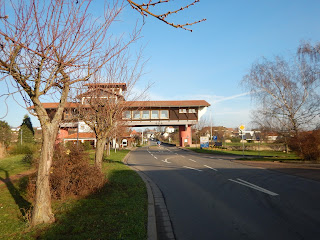
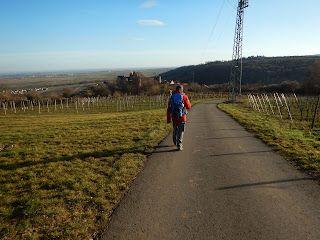
We followed red and white signs up into the vineyards, still naked and heavily pruned, gradually rising above the Rhine Plain. Gravel tracks, tarred roads, pausing to take in the landscape or watching the hawks wheel overhead. Small holes and runways suggested large populations of field hamsters or mice and despite the numerous lazily turning wind turbines, there seemed to be plenty of large birds of prey ready to eat them. We walked through open country, with copses of trees or bushes covering piles of limestone, along rows of vines and past occasional ancient signs of settlement. There was the blackened chunk of stone, perhaps the site of Celtic rituals, close by an early Christian chapel. For some time we met no one, then a family by a picnic table where we, too, stopped for a snack, and at the end of the day reckoned we had encountered nine people, including a woman on a horse.

We continued to climb and then descend into minor valleys, open fields much too green for January and then a steep descent into Mertesheim, once a centre of mining for ores. The road along the valley was the first we had seen or heard in the last couple of hours. From here onwards we were walking over sandstones, that produce infertile soils and are mostly left as woodland which covers nearly all the main uplands of the Palatinate Forest. Both of us were beginning to feel the effects of distance and height climbed, so we both needed cups of lemon and ginger tea and a power bar as we reached the top of the hill above Grünstadt. After walking through a small park we found ourselves leaving the woods again and realised that in the distance to the NE we could see the Donnersberg at 686m, the highest in the Pfalz. Onwards and around the next hilltop our view changed, back to vines, the horse and rider and below the line and drone of the A6 Autobahn. The road itself is well-known to us, one of our routes back to the UK, but it also meant that we were now very close to Neuleiningen. All day we had been buffeted by a chilly wind in our faces and now the low sun reminded us of the shortness of the daylight in January. We marched the next few kilometres, past farm and restaurant, to the road tunnel beneath the A6 and into Neuleiningen at a good pace.
We made it to the bus stop near the castle with about 10 minutes to spare, then into Grünstadt where the railway station still has the original Ludwig's Railway wrought iron stanchions holding up the wooden canopy. The Palatinate was ruled by Bavaria when the railway was built. A good day's walk in bright winter sunshine, where we had never been before.


Sunday, 21 February 2016

Food in Germany country inns

The food in these restaurants and pubs is normally very simple but wholesome and the portions are enormous. If you stop for lunch or dinner then order a Senioren (pensioner) or a klein (small) portion. If you don't you will not be able to walk afterwards.
This is a small schnitzel with cheese sauce and Bratkartoffeln (sauteed potatoes):


A vegetarian on our table ordered noodles with tomato sauce and had trouble finishing:


If we are wrong then you can tuck into a small cake afterwards:

Saturday, 20 February 2016

Walking and baggage transfer in Rheinland-Pfalz (Rhineland-Palatinate)

Rhineland Palatinate is making serious efforts in tourism.  Various companies in the south of the province are offering services to cyclists and walkers that we feel are worth knowing about. We are writing a guide to the the Weinsteig and as we find info about these services we will pop them on the blog.

Gepäckservice Pfalz (Palatinate Luggage Service) based in Deidesheim, offers both walkers and cyclists the chance to have their bags carried. We ourselves are not madly bothered as cyclists about having somebody carry our gear, but it could be interesting for a walker, especially if you are walking, for example, the Weinsteig from Bockenheim to Rechtenbach-Schweigen near Wissembourg (Alsace) as part of a grand European tour, you may well have more gear and if you can pack the essentials for each day in a day sack. If you do not plan to take a day sack Decathlon in Mannheim and Ludwigshafen will sell you a 10L pack for under €3 and 20L one for €8. If you use this service you can inform the company each evening where you will be stopping the night after. They pick up your bags on the next morning.

Gepäckservice Pfalz, Kirschgartenstraße 49, 67146 Deidesheim, Germany, http://www.gsp1.de/ (In German), info@gepaeckservice-pfalz.de, T: +49 (0) 6326 982284
Baggage Transport:
1-2 people/day  €20
3 people/day €27
4 people/day €36
Each extra person €2.50
The company also rents out touring bikes.

The official provincial or regional tourist office will also book the overnight accommodation and baggage transfer for a walk along one of the many regional walks: Pfälzer Hohenweg, Pfälzer Waldpfad, Pfälzer Weinsteig. This a good idea if you don't know your "der" from your "das". In this case however you don't have the flexibility to stay somewhere for another day. Prices seem reasonable: from about €150 a day for bed and breakfast for two people sharing a double room with bath/shower and WC.
Pfalz Touristik e.V., http://www.wandermenue-pfalz.de/en/home/, info@pfalz-touristik.de,
T: +49 (0) 6321 39160

Saturday, 25 April 2015

Provincial Horticultural Show Landau 2015 / Landesgartenschau Landau 2015

Although the majority of hill walkers prefer to get mud on their boots walking, there may be the odd one apart from my wife who is interested in gardening. In which case if you are thinking of walking in the southern Palatinate you would be well advised to get off the train in Landau, or if driving through southwest Germany follow the instructions on the website and look at the Landesgartenschau there.

Monday, 2 March 2015

Walking in Winter I

We live in the Rhine Valley bounded on the west by the Pfälzerwald hills and on the east by the Odenwald hills, both good areas for walking, even in winter. Leaving the small town of Bad Dürkheim last week the air was crisp so we enjoyed the walk up to the Flag Tower, above, a folly erected basically to improve the view. Here the vines had been pruned leaving one shoot which later would be tied to the wires and bear this summers grapes. Now we had warmed up after our longish tram ride and set off along the marked Weinsteig (Wine way). Winter trees displayed their trunk and branch structures like this birch and even the roadside bushes revealed their inner secrets.

What a difference blue skies make, especially as we found hazel catkins round the corner (see below). Soon we reached one of the more exacting stages of the walk. The trail narrows and the land falls steeply away through the stands of mostly Scots Pines. Last year people started to pile small cairns precariously on wayside stones and some of these have survived the winter frosts and gales. Smaller birds twittered encouragingly in the undergrowth, whilst later large hawks circled over the woods
We found a convenient bench to have our picnic, overlooking a boule pitch as our route descended to cross the road to Wachenheim and then continued up to the castle nearby. The days were still short so we pressed on, mostly in the woods, up and down, following the red and white markers towards the prosperous wine-making town of Deidesheim. On the last hilltop above the town lies the curious ancient remains of the Heidenlöcher, where a drystone wall of Celtic origin encloses roughly rectangular holes where people lived when their villages were threatened. They date from around 800 AD, possibly from when Viking invasions along the Rhine were frequent.
The Flag Tower built as a folly to give the wellness guests in Bad Dürkheim somewhere to walk to.

Wintry trees 
Hazel Catkins

Cairn building is popular in Germany

Saturday, 27 December 2014

Upgrade of the Palatinate Weinsteig, Germany

One of our favourite long distance walks is the Weinsteig that runs along the edge of the hills bordering the Rhine Valley for 170km from near Grünstadt almost to the French border in Wissembourg. This has recently been upgraded by installing picnic tables at a number of viewpoints into the valley.
If you decide to walk in this area however there is some bad news, in that the Pfalzer Wald Verein, the regional walking club, is closing or reducing the hours of opening of its manned huts, where one can obtain refreshment. The problem is due to introduction of a minimum wage in Germany. This will push the costs of paying the volunteers who man the counters and kitchens up by several hundred percent. More information is available in German on: http://www.pwv.de/index.php/aktuelles/232-mindestlohn-wka-smartphone If you decide to walk the route and intend to eat at a PWV hut, then check the opening hours of the club's huts before setting off.

Sunday, 20 July 2014

Walking with luggage transfer along the Weinstraße, Rhineland Palatinate, Germany

We have walked and enjoyed several stages of the Weinsteig a slightly tougher version of the German Weinstraße route. The 165km long route starts just over the border from the French town of Wissembourg and proceeds along the edge of the hills bordering the Rhine to Neuleiningen through Neustadt an der Weinstraße and Bad Dürkheim. The excellent Kleins Wanderreisen offer a 14 day trip for just over €800 pp for two people sharing a room with bed and breakfast in hotels and vintners accommodation, with luggage transfer starting each Sunday. If you want to book your own accommodation Gepäckservice Pfalz will arrange luggage transfer for €20 for one or two persons.

Saturday, 6 April 2013

The Weinsteig Part III Deidesheim to Neustadt a d Weinstreaße and disaster strikes.

We took the S-Bahn from Mannheim to Haßloch (Pfalz) and changed to bus 513 to Deidesheim. If you are tempted to take this route be warned: We had three minutes to get from the platform to the bus stop. We did not hang about and as soon as we sat down the bus was away.  We left Deidesheim station and took the Bahnhofstraße past the fountain in front of the Tourist Information Office. The fountain is worth five minutes of your time. You can take each others' photographs "wearing" bronze clothing and admire the goat with droppings and the mouse without. We picked up the yellow and red waymarkers showing the feeder route to the Weinsteig easily. We turned left at the end of the Bahnhofstraße to reach the Marktplatz, the square in front of the Deidesheimer Hof, a restaurant visited by the great and the good when Helmut Kohl was Federal Chancellor. However the restaurant still serves basic Pfälzer food like live dumplings, Saumagen (stuffed pigs stomach) and sauerkraut at reasonable prices. You can also eat a four course gourmet meal for €66 with a different wine for each course. We put ourselves out of temptation and took the Heumarktstraße on the far side of the town hall following the red and yellow waymakers. We passed the swimming baths and climbed through the vineyards towards the Pfalzblick, a restaurant. Along the way the markers changed colour to the familiar red and white squares. We walked along the edge of the forest overlooking the vineyards before dropping down into Gimmeldingen and then climbing back in to the forest into the Gimmeldingener Valley with its three guest houses. By Forsthaus Benjental, the last one we started the four kilometre up hill hike (300m) to the summit of Weinbiet hill. The path is not good and care was needed. The Pfälzer Wald Verein (Palatinate Forest Club) restaurant was shut. It was Friday and Ruhetag. Once away from the summit the wide smooth path dropped steadily and somewhere along here I tripped over my feet. I fell heavily, cut my knee and bruised my left side. I will take walking poles in future. Judith played the nurse and applied sticking plasters. I hobbled along dribbling blood on my trousers to the stone deer, a carving by whom we don't know.


There is a wet red spot on my right leg.
We climbed down the technically difficult section by Wolfsburg (the exposure is quite fierce) and took another waymarked feeder into Neustadt. We visited an Apotheke - a chemist's shop to buy plasters, a bakers for a cup of coffee and the station to catch the S-Bahn back to Mannheim.
The route is well waymarked and we did not use our guide or our map.

Wednesday, 27 March 2013

The Weinsteig Part I Neuleiningen to Bad Dürkheim

The Weinsteig is a new trail that runs parallel to the Weinstraße on the western edge of the Rhine Valley from Neuleiningen near Grünstadt  to Wissembourg just over the border in France . It is a little more strenuous than the older Weinstraße trail.  We intended to walk the Weinsteig on cold clear days this winter, not in one fell swoop but on individual days.  We had just two days this winter which were not half bad when we walked the Weinstraße trail from Bad Bergszabern to Wissembourg to prepare a tour for a Mannheim club. Unfortunately the weather this winter was mainly wet and cold. so we have had to wait  for spring to start the walks.
We took public transport to the start and had a sense of an older more romantic Europe on Mannheim Hauptbahnhof (main station) when we saw the Copenhagen - Basel CityNightLine train with a sleeping car from Moscow. When the carriage left Moscow I am not too sure. In my early days as a commuter from Weinheim to Frankfurt I used to regularly see the Zürich - Moscow sleeper that  stopped in Weinheim with its coke stove heated Russian carriages three times a week. I always wanted to climb on board and drink tea from the samovar.
We took  less romantic regional trains and then a bus from Grünstadt up to Neuleiningen and walked into the village clustered around the partly ruined castle. It seems to be home to an amazing number of architects' houses and offices. We had the usual problem: The lack of signs. Any sign whether Weinsteig, Weinstraße, Drei Burgen (Three Castles)… all lead the same way. There are plenty of good looking pubs in the village. We dropped off the edge of the village and went through Neuleiningen Tal (valley) which is in the valley and then climbed up to Battenberg. The Weinstraße Trail went off to the left before the climb up to Battenberg became serious and so we only had three sets of markers, the red and white Weinsteig sign, a Pfalzer Waldverein sign consisting of a white and a blue horizontal strip and the  Drei Burgen to follow. We wandered off to the right to look at the Blitzrohren - tubes of iron oxides originally laid down horizontally and then shifted vertically as the rift valley was formed. 

We followed a track through the forest slight up and down but climbing all the time. Hill walking is different to cycling. When cycling one looks for short steep climbs where one can push, but not for long followed by a long gentle descent, whereas walkers prefer the reverse.
We visited the Bismark Tower, wandered past the Celtic wall and descended very steeply past the Roman quarry with its ancient graffiti to arrive on the outer edges of Bad Dürkheim. We found our way in to the centre of the town, more by good luck that judgement and found a café to eat the celebratory cake. There were few signs.
The next problem we faced was how we got out of the town, but enquired of a native and managed to find the tram station by the DB railway station to head for home.

Saturday, 23 February 2013

Bad Bergzabern to Wissembourg


The "I don't know much about art, but I know what I like" fountain in Bad Bergzabern

On an earlier attempt the weather was much clearer.
Meanwhile we haven't got too far with our winter walking aim of doing the Weinsteig Trail along the W edge of the Rhine Valley 10 to 14 km sections at a time - the weather has mostly just been too nasty and unsettled. However yesterday buoyed falsely by the weather forecast - cloudy, cold but mostly dry - we headed out by local train to Bad Bergzabern, a wine growing centre and spa towards the southern end of the Weinstraße


The stylised bunch of green grapes waymarks the trail.
As one does we've promised to lead a group from our cycling club on 17th March, along this section. As the time does go faster apparently or more slowly somehow we were beginning to run out of days when we could take another dry run at this - looming up are dentist visits, museum trips, other walks, retirement parties, visiting friends recovering from hospital and all the other activities that take time, and that is even before one of us has laid a foot in the garden apart from taking the compost out. Clearly the weather gods over in Rheinland Pfalz had not received yesterday's SW Germany's weather forecast since it was snowing almost the whole day with a wind direct from the Urals, but calling on the spirits of Shackleton and Shipton we marched on, meeting just one youth and a rather roly poly sausage dog underway. We ate our sandwiches rather quickly, sheltering behind a log pile and then hastening through some blasted vines (surely these withered sprouts will never produce Riesling, as the notices proclaimed) and then into the shelter of the woods where great fallen trees rubbed against other branches with unearthly squeaks. A buzzard flew silently past and later a kestrel hovered yards away and then swooped on a tiny mouse, enough for a few minutes of tearing apart on the fence post across the fields.
We had climbed through vineyards and forest to Dörrenbach,  dropped through Oberrotterbach and climbed to a ridge before we had a our first view of the the Weintor. It was probably one of the coldest walks I've ever done, though neither of us was ever cold for more than a few minutes, well protected by high tech layers as we were. We reached Wissembourg, just over the French border, following the wine route to its close on the German side via the Weintor, a totally pointless and brutalist style gateway, built in the time of the late, unlamented NS.
Rather than walk down the footpath by the side of the main road from Schweigen into Wissembourg, we turned off right by the large restaurant by the roundabout south of the Weintor. There we discovered a whole set of small vintners and interesting looking family style hotels and eateries - mostly closed for the winter.   Five minutes later we crossed the French border on foot, reached the outer suburbs of Wissembourg after two kilometres, climbed over the remains of the earth ramparts into town past the protestant church. We wandered into town past a house where Charles de Foucauld, a French mystic and missionary amongst the Touregs in Algeria had spent his early years and also past a house formerly belonging to the Bartholdi family. One member of this family was Frédéric Auguste Bartholdi who designed the Statue of Liberty. Interestingly enough there are plaques on various houses with information about them in French, German and English. The French appear to receive the most information, the Germans somewhat less and the British very little. Maybe the city fathers of Wissembourg think  English speakers are less than interested in European history.
In Wissembourg too some of our favourite watering holes were closed but promising to reopen before March 17th, when we may indulge in cafe au lait and mille feuilles after we have guided the walking cyclists to this paradise for pastry freaks (These delights are not available in Viernheim, fortunately).  We had time to nip into a supermarket to buy some cheese and then we took the train home. A good day.


Sunday, 18 November 2012

Why fly to New England?

We have enjoyed a superb autumn/fall this year and if you wish to enjoy walking through golden woods with good food and wine, then it is worth thinking about southwest Germany in October. The photographs below were taken over the last month or so in the vineyards of Rhineland Palatinate, in the Löwensteiner Hills near Heilbronn, in the Odenwald and in the Viernheim forests.


Saturday, 27 October 2012

Die Weinstraße

The Pfälzer Weinsteig (Palatinate Wine Trail runs for about 160 km (100 miles) from Neuleiningen to the Weintor at Schweigen-Rettenbach, just north of Wissembourg in Alsace. The route traverses the foothills of the Pfalzerwald (Palatine Forest) through vineyards, past castles and Ludwigshöhe, a Royal Bavarian summer residence. The climate is warm here in the summer with almond, fig and edible chestnut trees. This is a major German wine growing area. It is especially fine in October when the leaves on the grape vines change colour from deep green to yellow, orange and deep red. It is a bit late for this year, but next year maybe? You will need some time to sample the wine and the local food which is rural, robust and simple, but not to be missed - Saumagen (pigs' stomach stuffed with hotpot and then sliced and grilled or  fried. This is the favourite food of Helmut Kohl, the former German Chancellor.), liver dumplings, Bratwurst, sauerkraut… The trail can be easily walked in either direction in 10 days - about 16 km and 700 m, just 2000' a day. You can expect to pay about €80 a night for a double room with B&B. Practically every village has a wine festival in the autumn, so booking head has a lot to recommend it. The organisations whose websites follow will help you find rooms: www.deutsche-weinstrasse.dewww.suedlicheweinstrasse.de or www.pfaelzer-wanderwege.de for details of pre-booked holidays with luggage transport, allowing you to just carry a day sack with a picnic and a waterproof.