Oberstdorf and the Klein Walser Valley are well known winter sports resorts adjacent to one another on both sides of the Bavarian/Austrian border, as far south as you can get in Germany. It might have escaped the attention of many British walkers that the area offers excellent walking in both summer and winter. We were recently there in early spring and enjoyed winter walking. There are thirteen winter walking routes in Oberstdorf, cleared of deep snow and waymarked, which combined with local transport make for an interesting week’s walking. Most winter walking routes are in areas that cannot be used for downhill skiing, along valley floors, or across hillsides that are too steep. There are solid economic reasons for this discrimination, since walkers bring in less income in winter than skiers. There are far more skiers than walkers. Skiers need to buy or hire all the expensive bits and bobs that they seem to need. After an adrenaline packed day sliding down the pistes, you need a few pints or a glass or two of bubbly in an aprés-ski disco, to relax, whereas walkers might just have a small cup of caffeine-free coffee on their return to civilisation.
Summer brings many more delights because the slopes and tops are not littered with ski pistes and skiers frightening themselves to death. In addition most if not all of the hotels, pensions, B&Bs, etc. offer free lift tickets in summer which means it is cheap and easy to get high to follow routes that anyone used to the British fells can walk among Alpine peaks. It is safe and good fun, as long as you remember that you are in the mountains. The weather can change rapidly and the paths can be narrow and rocky, so you need appropriate clothing and footwear.
Our Week
We arrived on Monday afternoon, found our B&B and then went for Kaffee und Kuchen - coffee and cake, a favourite Austro-Bavarian activity in the afternoon.
The next morning we discussed where to walk with our landlady. She suggested we took the lift to the summit of (Mount) Ifen over in Austria and follow a circular walking route amid the skiers. She had been up the hill the day before and spent the afternoon skiing. We took a bus to the base station of the Ifen chairlift and then two lifts to the approximately 2000m summit. We followed the waymarked route up and down dale across the Gottesacker Plateau. It was a perfect day with an almost cloudless sky and clear air giving us wonderful views across the Alps. It was well worth the 20€ cost each for the chairlift.
 |
| The view from the plateau |
 |
| Avoiding members of the British Army on skiing practice |
The weather forecast for Wednesday was for cloud, but no rain. We followed Oberstdorf Tourist Office's Winter Walking Route G. This started by the Edinger Ski Jump Arena and as usual we had difficulty finding the start of the trail in the town. It's always difficult finding your way out of towns and cities, the signposting gets lost in the forest of urban signs. We managed in the end, found the route and climbed steeply, had a nervous moment running across a red ski route piste in deep snow and then climbed gradually along a rough track through forest to 1200m in sun and shadow. It was good to see the first spring flowers. We returned along a lower level route along the valley floor, through open fields to Oberstdorf.
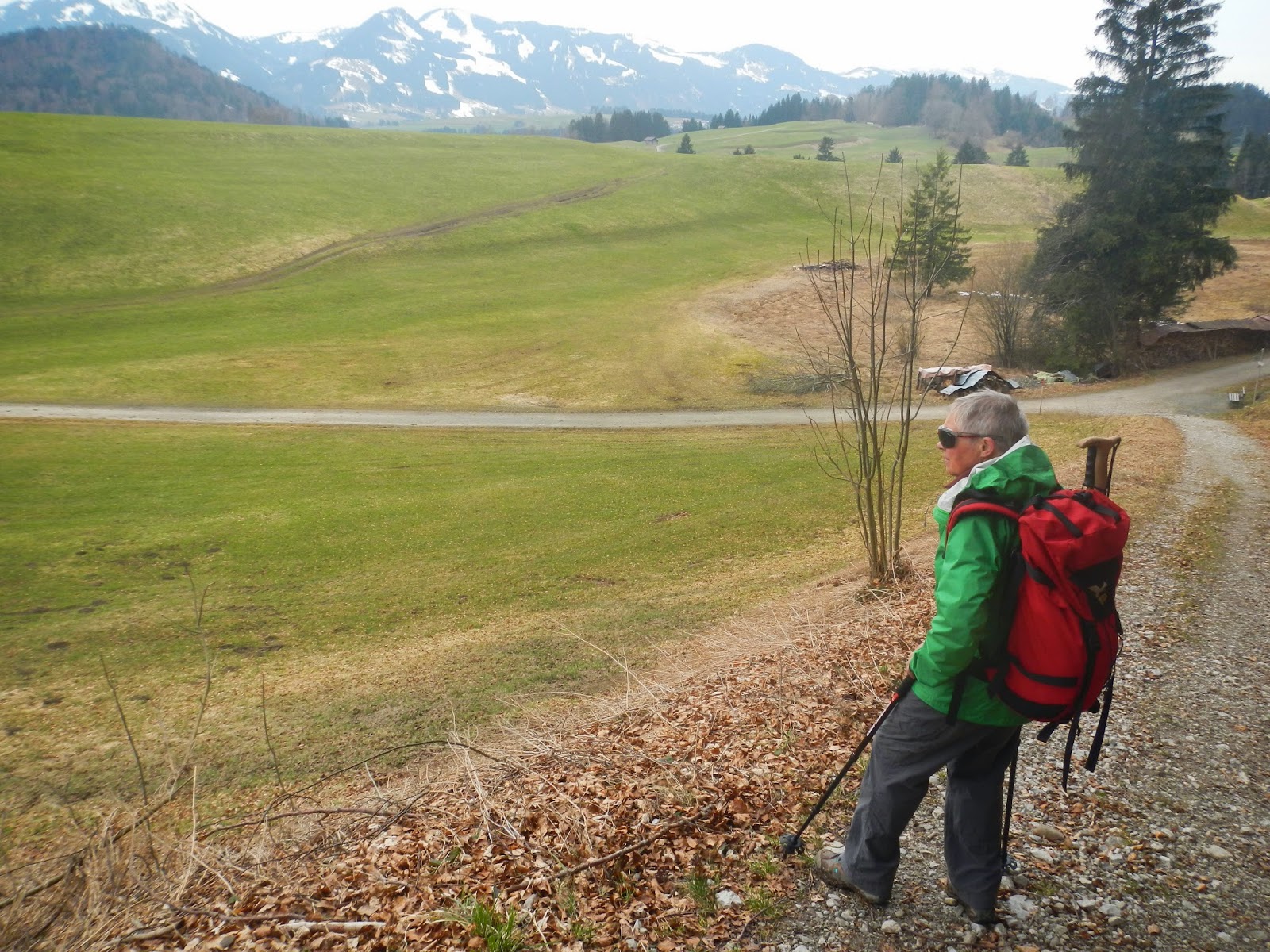 |
| Dropping into the valley on our way back |
 |
| Small but on their way, the first spring flowers |
Thursday's forecast was for rainy periods. We mooched about in the morning and sat in the Oberstdorf Haus, a social centre with café and reading room. We could have used its free WLAN, but we already had Internet connection back at the B&B. In the afternoon when the promised rain did not arrive, we followed a 5km nature trail around an artificial lake in a Moor (German for a swampy area) just south of the town centre.
On Friday we caught a bus to the Söllereckbahn cable car and ascended through a snow storm, sitting in a warm gondola rather than being exposed to the elements on a chairlift. We ate lunch in the jolly farm restaurant at Schrattenwang Alpe. The habit of knocking back a quick slug of schnapps at lunchtime to help the digestion and keep out the cold was much in evidence amongst the skiers eating in the farmhouse. This increased our determination to be extra careful when crossing ski pistes. Having made sure that the blue run behind the restaurant was empty, we nipped across the piste and followed a signposted trail across the border through snow to Riezlern in the Austrian Klein Walser Valley through woods and meadows partly in sunshine but also in a heavy snow storm. We took a bus from there to Oberstdorf.
 |
| High above the Klein Walser Valley |
On Saturday the weather forecast was for sunshine and clear skies and it was absolutely correct. We took a bus to the Skiflugschanze, a ski jump complex in the south of Oberstdorf and then walked initially uphill through a series of small hamlets to the Fellhornbahn (cable car). There we ate
Kaiserschmarren (sugared strips of buttery pancake with raisins) for lunch on a sunlit terrace. Heavenly and non-fattening! We walked on to Birsgau and Einödsbach. The latter is the southernmost inhabited community in Germany, unfortunately without a bus stop, so we returned to Birgsau and its bus stop.
 |
| Judith enjoying a touch of haute cuisine - Kaiserschmarren |
Our last day was Sunday. The weather forecast was dire, so we planned initially to go swimming in the Therme, a number of linked swimming pools including a pool with a wave generator. After breakfast we looked out and decided we did not need to build an ark yet. As we can go swimming at home we decided to walk. Walking in the mountains is difficult in the Rhine Valley. We took the same bus route as the day before but got off the bus before the Skiflugschanze and walked to Spielmannsau, a hamlet with a few houses and an inn at the end of a dramatic Alpine Valley. I found the first part of the route less attractive than the route the day before as we walked on minor roads up to the hamlet. The inn is run on sustainable lines. It was rebuilt using much of the timber from the old inn. All of the waste heat in the kitchen is recycled via heat exchangers. The hamlet has a full biological sewage works. The WCs are flushed using grey (filtered waste water from washing processes or untreated rain or spring water) rather than drinking water. Solar generated electricity is used to heat water for washing and cooking. On our return we took the other side of the valley which is largely traffic free and walked into a serious rainstorm, that lasted the two hours or so until we reached Oberstdorf.
 |
| Spielmannsau, not quite the end of the world |
Eating
Our usual habit when we stop somewhere for a week is to try a few restaurants in the first few days and then return to the ones where we ate well, later in the week. We prefer restaurants selling decent portions of local food to Michelin starred restaurants offering a sculptured half carrot artistically arranged on the plate with a swirl of sauce. There may be some of the latter in Oberstdorf, we did not look for them. We found four Bavarian restaurants where we'd eat again and suspect there are many more:
"Oberstdorfer Einkehr", Pfarrstraße 9, 87561 Oberstdorf, T: +49 (0) 8322 977 850, www.oberstdorfer-einkehr.de (in German)
"Zur alten Sennküche, Lorettostraße 2, 87561 Oberstdorf, T: +49 (0) 8322 9589971, www.alte-sennkueche.de (in German)
"Cafe Bistro Relax", Hauptstraße, 87561 Oberstdorf, T: +49 (0) 8322 7851, www.bistro-relax.de (in German)
"Alt 168", Kirch/Nebelhornstraße, 87561 Oberstdorf, T: +49 (0) 8322 987078
Portions are immense and it is a good idea to order a pensioner's meal: "Senioren Teller", if you are not used to eating several days meat ration during one meal. It struck us that vegans would have problems, but as cheese plays major role in cooking in the Allgäu vegetarians could find more choice as long as they watched out for the Schinken (ham) cubes scattered liberally across some dishes. As a guide we paid on average about 40€ for the two of us for one or two courses and a beer each. The price depended on the meal and the restaurant. The range was 25 to 55€. The restaurants offer many beers: dark light, wheat and alcohol free and obviously a good range of wines. The beers have at least 5% alcohol, stronger than most British beers. There is an Irish pub in the town centre, if you cannot live without the Guinness.
Accommodation
There is a wide choice of accommodation from Ferienwohnungen (self catering holiday flats with and without breakfast) through B&Bs to upmarket hotels. We stopped in a B&B - Gästehaus Hofacker (www.gaestehaus-hofacker.de, in German, English, French and Spanish) which is within walking distance of the town centre and railway-bus interchange. Location in Oberstdorf is important. The town covers a large area and it pays to check where your accommodation lies, because the town bus which links all the important locations stops at 6pm which could mean a twenty minute walk or a taxi ride after dinner in the town centre where most of the restaurants and cafes are. Our B&B cost us 74€ a night for a large light, comfortable double room with ensuite facilities , TV with BBC World and CNN, and a fridge and electric kettle/crockery/cutlery. Our landlady spoke German, English and French. We always spoke German to her. In addition we paid 2.60€ Kurtax each, a daily visitors charge. Paying Kurtax gives one an Allgäu Walser Card giving a range of reductions for the cable cars, at swimming pools and museums, etc. including a reduced price public transport ticket (19€ each for a week). Because it was low season, we also enjoyed a seven nights for the price of six package.
Travelling to Oberstdorf
The journey to Oberstdorf from the UK is quicker than one would expect. The nearest international airport is Munich. There are frequent trains from Munich Hauptbahnhof (main station) to Oberstdorf taking about two and a half hours. At the time of writing Ryanair has a daily flight from London Stansted to Allgäu Airport in Memmingen which has good bus and rail connections to Oberstdorf. Those who do not wish to fly can travel from London to Oberstdorf in about 11 hours mainly on TGV/ICE changing in Paris, Mannheim and Augsburg or take the Stena Line DutchFlyer option in about 24 hours sleeping on the Harwich to Hook ferry via Harwich, Hook of Holland, the Rhine Valley and Ulm to Oberstdorf. There are many more details on www.bahn.com and www.stenaline.co.uk/ferry-to-holland.
Sponsorship
We were not sponsored by any organisation and paid all our costs ourselves, unfortunately.


